
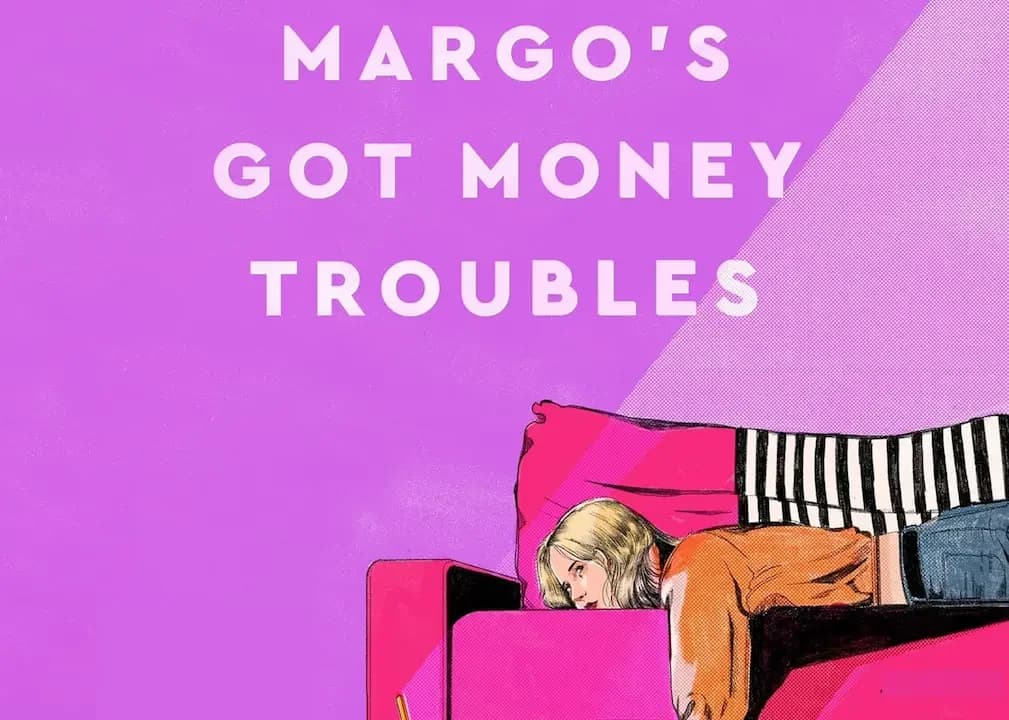
Spoiler warning: This article discusses major plot points from Rufi Thorpe's novel Margo's Got Money Troubles. Save it for later if you have not read the book and want to go into the Apple TV adaptation cold.
The 30-second answer
Margo’s Got Money Troubles is less interested in whether online sex work is purely empowering or exploitative than in who gets to define respectable survival. Through Margo’s motherhood, money pressure and performed online identity, the novel shows stigma operating as a form of social control. Psychological concepts help name those patterns, but this is literary interpretation rather than diagnosis.
Rufi Thorpe's Margo's Got Money Troubles looks, at first glance, like the kind of novel people reduce to one sentence at parties. Young single mom. Money problems. OnlyFans. Chaos. But that summary misses the thing the book is actually doing. This Margo's Got Money Troubles psychology reading is not about whether Margo is “empowered” enough, pure enough, or respectable enough for polite company. It is about what happens when a young woman's survival stops looking pretty.
The Apple TV adaptation premiered on 15 April 2026, bringing the novel’s questions to a wider audience. One of the sharpest remains: why is moral scrutiny so often concentrated on women who perform sexual labor while owners, platforms and consumers recede from the frame?
Key Takeaways
- This novel is not scandalous because Margo starts an OnlyFans. It is scandalous because Thorpe refuses to prettify female survival.
- Margo is judged before she is ever judged online.
- The book understands that money pressure does not just create stress. It narrows your world, your bandwidth and your range of “acceptable” choices.
- Thorpe is deeply interested in how motherhood gets turned into a moral ranking system.
- Jinx matters because he brings play, performance and anti-shame energy into a story that could otherwise suffocate under judgment.
- The novel is not a sermon about sex work. It is a far more interesting book than that.
Spoiler warning and why this novel hit a nerve now
What makes Margo's Got Money Troubles feel so contemporary is not just the platform detail. It is the atmosphere around it. We live in a culture that loves female confession right up until the second it becomes inconvenient. We want women to be vulnerable, but only in the approved register. We want them candid, but not messy. Sexy, but not commercial. Maternal, but not tired. Scrappy, but not strategic. Margo blows through those neat little categories almost immediately, which is one reason the novel feels alive.
Thorpe's gift is that she does not write Margo as a symbol first and a person second. Margo can be petty, smart, funny, impulsive, self-aware, naive and morally scrambled in the same paragraph. That is exactly right. Under pressure, people do not become cleaner versions of themselves. They become more cornered versions of themselves (Mullainathan & Shafir, 2013).
This is not really a book about OnlyFans
Yes, OnlyFans is central. Yes, the book is explicit about the platform logic. Yes, it matters that Margo starts making money by converting sexual attention into income. But saying Margo's Got Money Troubles is “about OnlyFans” is a little like saying Maid is about mopping. Technically true, spiritually vacant.
The real subject is being judged. Judged for wanting. Judged for needing money. Judged for being attractive. Judged for being young. Judged for being a mother. Judged for being legible to men online in a way that can finally be monetized by her rather than merely extracted from her. Stigma research is useful here because stigma is not just dislike. It is labeling plus stereotyping plus status loss plus unequal power (Link & Phelan, 2001). Margo does not simply experience disapproval. She gets sorted. That is why the novel keeps feeling larger than the plot summary. It understands that women are often forced to survive inside categories that were designed to shame them in advance.\
If you like this kind of psychological reading of Flowers in the Attic, Thorpe’s novel hits a similar nerve, though in a much more contemporary register.
Margo is judged long before the account exists
One of the smartest things in the book is that Margo's moral exposure begins well before the platform. The affair with Mark, her professor, already places her in a social story people think they understand. The pregnancy intensifies it. And Thorpe does not sentimentalize the decision to keep the baby. Margo's thinking is messy, prideful, defensive and recognizably human. At one point, she frames keeping the baby partly as proof that the people around her cannot bend her conveniently to their will. That is not a glossy feminist speech. It is a psychologically believable reaction to pressure.
This matters because it ruins the lazy reading that Margo's life becomes morally complicated only once money and sex become visibly linked. No. The book's point is harsher than that. She was already being watched through a moral lens. OnlyFans just makes the watching easier.
The professor dynamic matters for the same reason. Thorpe captures something many novels flatten. Power imbalances are often most psychologically confusing when the more powerful person insists that you have the power. That does not erase the asymmetry. It makes it harder to name. Margo understands this in a jagged, partial way, which is exactly how people often understand coercive or unequal situations while they are still inside them.

Scarcity makes every choice feel morally loaded
Money trouble in fiction is often treated like weather. It is there to move the plot. Thorpe is sharper than that. She shows how scarcity changes cognition. Rent is not just rent. Rent becomes the lens through which dignity, time, sex, motherhood, sleep and future planning all get distorted. Scarcity research has made this point for years: when you have too little, the immediate problem colonizes your mental life and shrinks the space for long-view decision making (Mullainathan & Shafir, 2013).
That is one reason the novel feels so convincing. Margo does not make choices from some serene bird's-eye view of her life. She makes them while tired, embarrassed, financially cornered and trying to keep a baby alive. People love to moralize from a position of surplus. Thorpe writes from inside constraint.
And once you see that, the tone of judgment around her starts to look even uglier. It is easy to tell women to make dignified choices when you are not the one trying to pay for diapers, rent, groceries and childcare in a world that is still set up to treat mothers like saints in theory and logistical inconveniences in practice (Hays, 1996).
Jinx, kayfabe and the strange gift of performance
Jinx is one of the reasons this book refuses to become a deadening issue novel. He brings warmth, absurdity and a completely different vocabulary for selfhood. Through him, Thorpe introduces wrestling concepts like kayfabe and heel work and that move turns out to be psychologically brilliant.
Because what is Margo doing online, really? She is not just “selling content.” She is building a character, managing perception, calibrating revelation and learning that visibility is never raw. That is true on OnlyFans, but it is also true across the attention economy described in Digital Dopamine. Women are trained early to understand how they are being read and to manage the gap between what they feel and what they can safely project. Objectification theory is relevant here because it helps explain how women come to internalize an observer's point of view on themselves (Fredrickson & Roberts, 1997). Margo's online persona makes that process unusually legible.
Jinx's great contribution is not that he gives her a hustle. It is that he gives her relief from shame. He treats performance as craft, not contamination. He sees her instinct for character. He helps her understand that persona can be a tool rather than a confession. That does not make the work simple or harmless. But it does interrupt the suffocating assumption that once a woman becomes sexually visible for money, she has morally degraded. Jinx, surprisingly, is one of the only people in the book who refuses that script.
Motherhood becomes a courtroom morality test
If the OnlyFans material gives the novel its premise, the custody material gives it its teeth. This is where Margo's Got Money Troubles becomes very explicitly a novel about who gets to define a “good mother.” Mark's move is not just strategic. It is culturally fluent. He understands that once Margo can be attached to sex work, a whole social vocabulary will leap into place around her.
That is what makes those sections so chilling. The issue is never merely Bodhi's welfare. The issue is whether Margo can still qualify as respectable motherhood once sexuality and money have become visible in the same frame. This is where the book feels painfully aligned with both the ideology of intensive mothering and the real-world motherhood penalty. Mothers are expected to be selfless, ever-available and morally immaculate, while research shows they are routinely read as less competent and less desirable as workers precisely because they are mothers (Hays, 1996; Correll et al., 2007).
The brutal little secret is that motherhood is often treated less like a relationship and more like a purity test. Thorpe gets that. The novel understands that the category of “good mother” can be used as a cudgel, especially against women whose labor, sexuality, class position, or style of survival makes middle-class comfort squirm.
If this book made you think, “Why do I blame myself so fast when someone else is clearly controlling the frame?”, take the free Attachment Style Quiz. It gives you a clearer read on closeness, reassurance, boundaries and the protective moves you default to under stress.
Take the free Attachment Style QuizMark's power is the point
Mark is not interesting because he is a monster in some theatrical sense. He is interesting because he knows how to sound reasonable while defending his own power. That is much more common and much more dangerous. His version of concern comes wrapped in legitimacy. He can present himself as worried, paternal, sober, protective. Margo, by contrast, is always easier to render unstable, indecent, impulsive, or contaminated by the wrong kind of labor.
This is one place where the sexual double standard matters. Women are still more harshly judged than men for behavior involving sex and those judgments become even sharper in social settings where norms are being actively enforced (Marks & Fraley, 2007). Margo's situation makes that pattern visible in high definition. Mark gets to position himself as the adult, the father, the educator, the rational one. She gets positioned as the risk. You can also see the emotional distortion of a pursue-withdraw cycle here, where one person controls the frame and the other is left reacting inside it.
That asymmetry is the whole point. The novel is not merely asking whether Mark is hypocritical. Of course he is. It is asking why his hypocrisy still travels so well inside respectable language.
So is the book saying OnlyFans is empowering?
Not in the lazy, slogan-heavy way people mean when they ask that. Thorpe is much too smart for that. The book does not pretend that online sexual labor is uncomplicated freedom. It also does not flatten it into degradation. It treats it as labor inside a stigmatizing culture, which is a more adult framework. Recent research on digital sex work points in the same direction: people involved in these spaces perceive intense societal stigma, even when their own views are more nuanced than the culture's stock stereotypes (Bennett-Brown et al., 2025).
That feels true to the novel. Margo's account gives her leverage, income, visibility, structure and a strange kind of creative control. It also exposes her. It changes how others see her and sometimes how she sees herself. Research on women's strategic self-presentation online is useful here too. Online persona-building can become tightly linked to approval, self-surveillance and adaptation to the gaze, especially for women already navigating objectification (Chen et al., 2023; Fredrickson & Roberts, 1997).
So no, I would not call the book “pro-OnlyFans,” and I would not call it anti-OnlyFans either. I would call it anti-simplicity. It understands that for women, the line between agency and adaptation is often not a line at all. It is a blur.
What the book is actually saying
What Margo's Got Money Troubles finally says, I think, is that women are judged not just for what they do, but for the conditions under which they do it. If a woman survives in a way that flatters the culture, she is resilient. If she survives in a way that embarrasses the culture, she is suspect.
That is why the novel sticks. It is not interested in whether you personally approve of Margo. Frankly, that is the least interesting possible response. It is interested in how quickly approval becomes the wrong question. The more revealing question is: why do we keep demanding that women survive beautifully?
And that is the book's quiet cruelty. Margo is never merely trying to make a living. She is trying to remain legible as a person while other people keep reducing her to a type.
What to take from Margo if you saw yourself in her
One reason this novel will hit a lot of women hard is that its emotional logic is familiar even if its plot is not. Plenty of women know what it feels like to be read unfairly, to be evaluated before being understood, to feel their worth collapse into one visible fact about them, to notice that the world has endless empathy for male appetites and very little for female improvisation.
If that recognition landed in your body while reading, I would not take the lesson to be “be more careful how people see you.” I would take it to be something closer to this: shame is often a social weapon before it is ever a private feeling. Once you know that, you can start asking better questions. Not “How do I look less judgeable?” but “Who benefits when women are forced to earn safety through innocence?”
For some readers, the feeling Margo produces is less about agreeing with every choice she makes and more about recognizing the panic, self-doubt and hypervigilance we talk about in anxious attachment vs relationship anxiety.
If fiction is useful, it is useful because it gives shape to the feelings we were half-afraid were only ours. Thorpe does that here. She gives us a heroine who is not clean, not saintly, not always wise and still very much worth defending.
FAQ
Is Margo's Got Money Troubles really about OnlyFans?
Only partly. OnlyFans matters to the plot, but the deeper subject is how women get judged when money, motherhood, sex and self-presentation collide. The book is much more interested in stigma and moral sorting than in platform gimmickry.
Why does Margo keep the baby?
Thorpe writes that decision as emotionally mixed rather than pure. Margo is not guided by one noble motive. Pride, pressure, defiance, attachment and moral confusion all play a role, which is exactly why the decision feels psychologically believable.
What does the novel say about motherhood and judgment?
It suggests that motherhood is often treated as a moral ranking system. Once Margo becomes legible as sexually visible for money, people start using “good mother” language to police her, not just to protect her child.
Why does Mark's custody move feel so psychologically ugly?
Because it weaponizes respectability. He takes a stigmatized fact about Margo's labor and folds it into a culturally familiar story about female unfitness, all while sounding concerned and reasonable.
What does Jinx represent in the story?
Jinx brings anti-shame energy into the novel. He gives Margo a language of character, performance and play that makes it possible for her to see online self-presentation as craft rather than automatic disgrace.
What is kayfabe doing in this novel?
Kayfabe helps explain that identity is often performed under pressure. In the book, it becomes a smart metaphor for online persona, strategic visibility and the way women manage how they are seen.
Is the book saying OnlyFans is empowering?
Not in any flat, sloganized way. The book treats digital sexual labor as both agency and exposure, both leverage and vulnerability. That ambiguity is one of its strengths.
Should you read the novel before the TV series?
Yes, if you enjoy getting the interior psychology first. The book's sharpest pleasures are in Margo's thinking, her self-justifications and the way Thorpe lets moral discomfort sit there without tidying it up for you.
References
A) In-text citations used throughout article
- (Thorpe, 2024)
- (Apple TV Press, 2026)
- (Reuters, 2026)
- (Link & Phelan, 2001)
- (Mullainathan & Shafir, 2013)
- (Hays, 1996)
- (Correll et al., 2007)
- (Fredrickson & Roberts, 1997)
- (Marks & Fraley, 2007)
- (Bennett-Brown et al., 2025)
- (Chen et al., 2023)
B) References
- Thorpe, R. (2024). Margo's Got Money Troubles. HarperCollins.
URL: https://www.harpercollins.com/products/margos-got-money-troubles-rufi-thorpe - Apple TV Press. (2026, March 9). Apple TV unveils trailer for highly anticipated new series “Margo's Got Money Troubles,” starring Elle Fanning, Michelle Pfeiffer, Nicole Kidman and Nick Offerman, and hailing from David E. Kelley.
URL: https://www.apple.com/tv-pr/news/2026/03/apple-tv-unveils-trailer-for-highly-anticipated-new-series-margos-got-money-troubles-starring-elle-fanning-michelle-pfeiffer-nicole-kidman-nick-offerman-and-hailing-from-david-e-kelley/ - Reuters. (2026, March 23). OnlyFans owner Leonid Radvinsky dies of cancer at 43.
URL: https://www.reuters.com/world/uk/onlyfans-owner-leonid-radvinsky-dies-cancer-43-bloomberg-news-reports-2026-03-23/ - Link, B. G., & Phelan, J. C. (2001). Conceptualizing stigma. Annual Review of Sociology, 27, 363-385.
URL: https://doi.org/10.1146/annurev.soc.27.1.363
DOI: https://doi.org/10.1146/annurev.soc.27.1.363 - Hays, S. (1996). The Cultural Contradictions of Motherhood. Yale University Press.
URL: https://yalebooks.co.uk/book/9780300076523/the-cultural-contradictions-of-motherhood/ - Correll, S. J., Benard, S., & Paik, I. (2007). Getting a job: Is there a motherhood penalty? American Journal of Sociology, 112(5), 1297-1338.
URL: https://doi.org/10.1086/511799
DOI: https://doi.org/10.1086/511799 - Fredrickson, B. L., & Roberts, T.-A. (1997). Objectification theory: Toward understanding women's lived experiences and mental health risks. Psychology of Women Quarterly, 21(2), 173-206.
URL: https://doi.org/10.1111/j.1471-6402.1997.tb00108.x
DOI: https://doi.org/10.1111/j.1471-6402.1997.tb00108.x - Marks, M. J., & Fraley, R. C. (2007). The impact of social interaction on the sexual double standard. Social Influence, 2(1), 29-54.
URL: https://doi.org/10.1080/15534510601154413\ DOI: https://doi.org/10.1080/15534510601154413 - Mullainathan, S., & Shafir, E. (2013). Scarcity: Why Having Too Little Means So Much. Times Books.
URL: https://www.hks.harvard.edu/centers/cid/publications/books/scarcity-why-having-too-little-means-so-much - Bennett-Brown, M., Gesselman, A. N., Blundell Osorio, M., Kaufman, E. M., & Campbell, J. T. (2025). Understanding stigmatization in digital sex work: Perceptions of camsite members and models. Computers in Human Behavior, 171, 108719.
URL: https://doi.org/10.1016/j.chb.2025.108719\ DOI: https://doi.org/10.1016/j.chb.2025.108719 - Chen, S., van Tilburg, W. A. P., & Leman, P. J. (2023). Women's self-objectification and strategic self-presentation on social media. Psychology of Women Quarterly, 47(2).
URL: https://doi.org/10.1177/03616843221143751
DOI: https://doi.org/10.1177/03616843221143751