
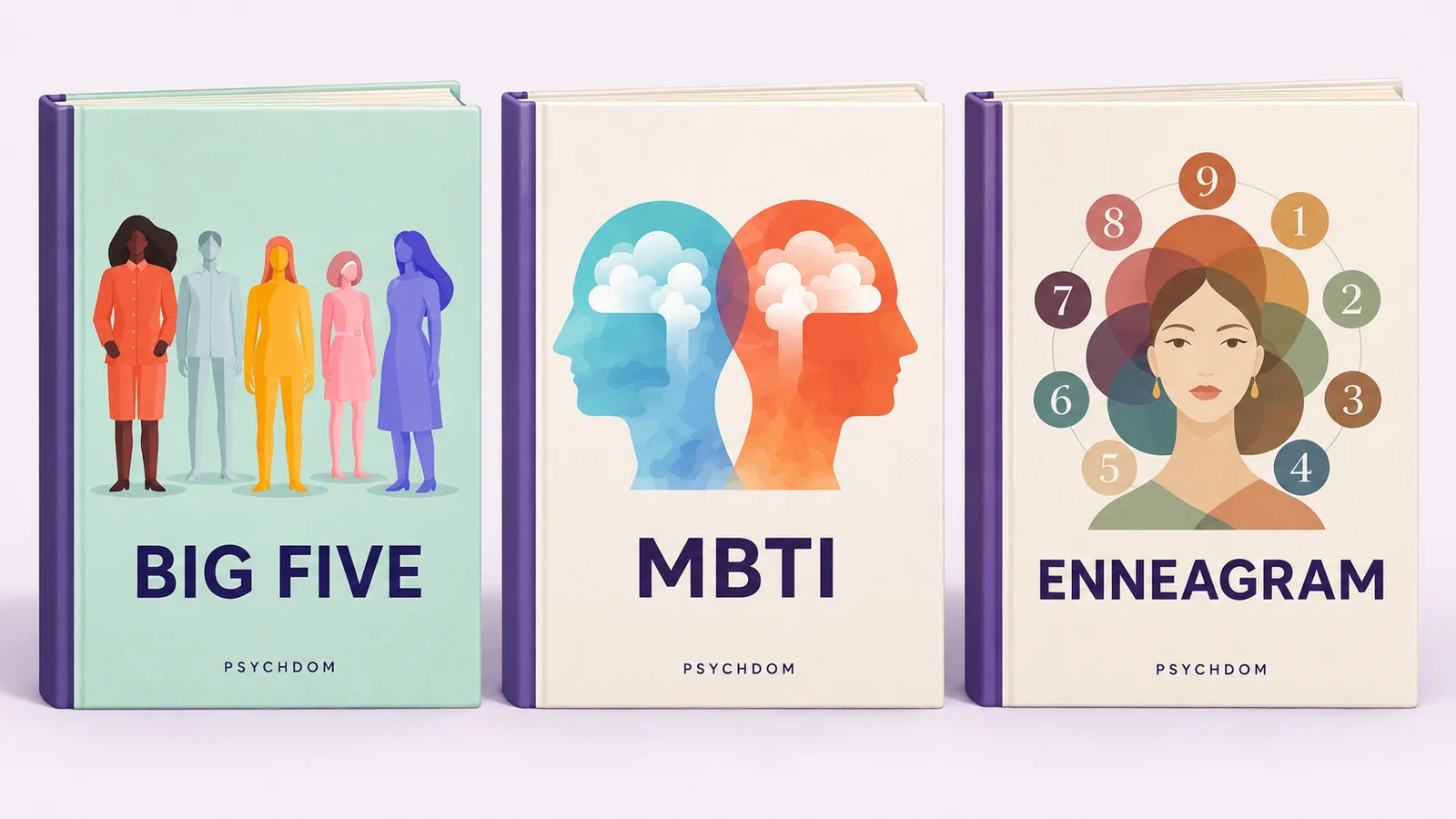
The Big Five describes personality through five broad trait dimensions. MBTI organizes preferences into 16 types. The Enneagram describes nine patterns centered on motivations and recurring concerns. Of the three, the Big Five has the strongest research foundation for measuring broad traits; the others offer different vocabularies for reflection, with different evidential limits.
This sounds straightforward until you open three results pages. One gives you a percentile, another gives you four letters, and the third gives you a number with a wing. Each seems to recognize you. None appears to be speaking quite the same language.
The temptation is to treat the results as pieces of one hidden code. Find the correct combination and, at last, your contradictions might make sense. A more useful starting point is less dramatic: what question were you hoping the test would answer?
The Big Five: how much, rather than which box?
The Big Five framework describes openness, conscientiousness, extraversion, agreeableness and neuroticism, often remembered as OCEAN. Some instruments use slightly different labels, such as negative emotionality for the last dimension. A score describes a position along a continuum rather than membership of an exclusive group.
That distinction preserves ordinary complexity. You can enjoy company without seeking it constantly. You can be organized about money and untidy at home. Broad traits summarize tendencies; more detailed facets may help explain the variation within them.
The research foundation belongs to a large family of studies and measures, not to a single commercial website. For example, Soto and John's development of the BFI-2 evaluated five domains and 15 facets across three studies. Those findings support that instrument. They do not automatically validate every questionnaire that prints “Big Five” above its questions.
If your aim is to describe your general tendencies in language that connects with mainstream personality research, the Big Five is a sensible place to start. Read the method as well as the result. Does the site explain what it measures, how scores are calculated and what the comparison group is? A percentile without a clearly described reference group can look more informative than it is.
Our guide to Big Five and OCEAN scores explains how to read the dimensions without treating high as universally good or low as universally bad.
Explore your Big Five traitsMBTI: a memorable language for preferences
The appeal of MBTI is partly editorial. Four letters make a compact story out of many answers. You can remember them, discuss them and use them to begin a conversation about how you prefer to engage with people or information.
The official Myers-Briggs framework combines preferences across four pairs: extraversion–introversion, sensing–intuition, thinking–feeling and judging–perceiving. Its familiar descriptions can give people permission to acknowledge a preference they had been treating as a defect. Wanting time to think before speaking, for instance, need not mean having nothing to contribute.
But the convenience of a category has a cost. Two people close to opposite sides of a scoring boundary can receive different labels despite fairly similar answers. Two people assigned the same label can differ substantially in how strongly they express a preference.
In a study comparing MBTI results with a five-factor account, McCrae and Costa found support for interpreting several MBTI scales as dimensions, rather than for genuinely distinct either/or types. The study also found relationships with several Big Five traits. Related dimensions are not interchangeable scoring systems.
The official MBTI code of ethics itself makes important distinctions: preferences are not abilities, intelligence or a forecast of success, and type should not be used to screen job applicants. A result can open a discussion about working together. It should not close the door on somebody's career.
Psychdom's MBTI-style personality assessment is not the official Myers-Briggs Type Indicator. The distinction matters when comparing claims about evidence, professional accreditation or administration. Our article on why MBTI remains so popular considers what its popularity tells us about the desire for a comprehensible account of ourselves.
The Enneagram: the story beneath a recurring reaction
The Enneagram's organizing question is often about motivation: what are you trying to protect, obtain or avoid? Its nine types offer narratives about recurring concerns, such as being competent, needed, secure or in control. People may find those narratives useful because the same outward behavior can have very different purposes.
Consider two people who volunteer for every difficult project. One enjoys the challenge; another fears becoming dispensable. A behavioral description alone may miss the difference. The Enneagram invites attention to the meaning a person gives that behavior, although identifying a plausible story is not the same as establishing that the story is true.
The evidence needs to be described carefully. A systematic review by Hook and colleagues, covering 104 independent samples, found mixed evidence for reliability and validity. Some findings supported aspects of the framework, but analyses often recovered fewer than nine factors. Research on secondary features, including wings and movement between types, was limited.
That leaves room for thoughtful use without inflating the claims. A description might prompt a worthwhile question: “Do I offer help freely, or do I struggle when it is not appreciated?” It cannot establish that all helpful people share one underlying motivation.
Use the Enneagram overview to understand its vocabulary, then approach a Psychdom Enneagram result as a hypothesis to examine against your experience. A description that feels uncomfortable is not necessarily profound; a description that feels flattering is not necessarily accurate.
A quick way to choose
Start with the question you can actually answer:
- “How would I describe my broad personality tendencies?” Begin with the Big Five and pay attention to the quality of the questionnaire.
- “What language might help me discuss preferences with other people?” An MBTI-style framework may be accessible, provided everyone understands its limits and nobody treats the letters as a rulebook.
- “What recurring motivations might be worth examining?” Enneagram descriptions can provide prompts, with the understanding that their research support is more mixed.
None of these questions is the same as “Which job should I accept?” or “Is this relationship right for me?” For work decisions, career interests and work values often bring you closer to the actual choice. For relationships, behavior under ordinary pressures usually tells you more than a theoretically compatible pair of labels.
When the results disagree
First check whether they really disagree. Being relatively introverted in a trait measure does not prevent you from caring intensely about relationships or enjoying particular social settings. A framework concerned with motivation may describe a different aspect of your experience from one concerned with frequency of behavior.
Then consider how you answered. Were you thinking about work, home or an unusually difficult month? Did you choose what you usually do, what you admire or what your current role demands? Self-report makes the respondent part of the measurement process.
Finally, resist the urge to keep testing until the description becomes entirely flattering. Choose one result and ask where it fits, where it fails, and what concrete observation would change your mind. Keep examples of both. A useful account of personality should survive contact with the unglamorous details of your week.
The best outcome is not a label you must defend. It is a clearer description you are free to revise.
Frequently asked questions
Which has the strongest research basis, the Big Five, MBTI or Enneagram?
Of these three frameworks, the Big Five has the strongest research basis for describing broad personality traits. That does not make every online Big Five questionnaire equally reliable; evidence about the particular instrument and its interpretation still matters.
Can I convert my MBTI type into an Enneagram type or Big Five score?
No dependable one-to-one conversion exists. The frameworks organize personality differently, and correlations between some dimensions do not make their scores or categories interchangeable.
Is Psychdom's MBTI-style test the official MBTI assessment?
No. Psychdom offers an MBTI-style personality assessment. It is not the official Myers-Briggs Type Indicator, and evidence or accreditation attached to the official instrument should not be assumed to apply to it.
Can a personality test tell me which career or partner to choose?
A result may suggest questions to investigate, but it cannot settle either decision. Skills, interests, values, circumstances and actual experience matter, as do another person's behavior and the relationship you build together.
Sources and scope
Research and professional guidance are linked at the relevant claims. These three frameworks are not diagnostic instruments for mental health conditions, and a general-purpose personality result is insufficient for employment selection, clinical decisions or judging a partner.