
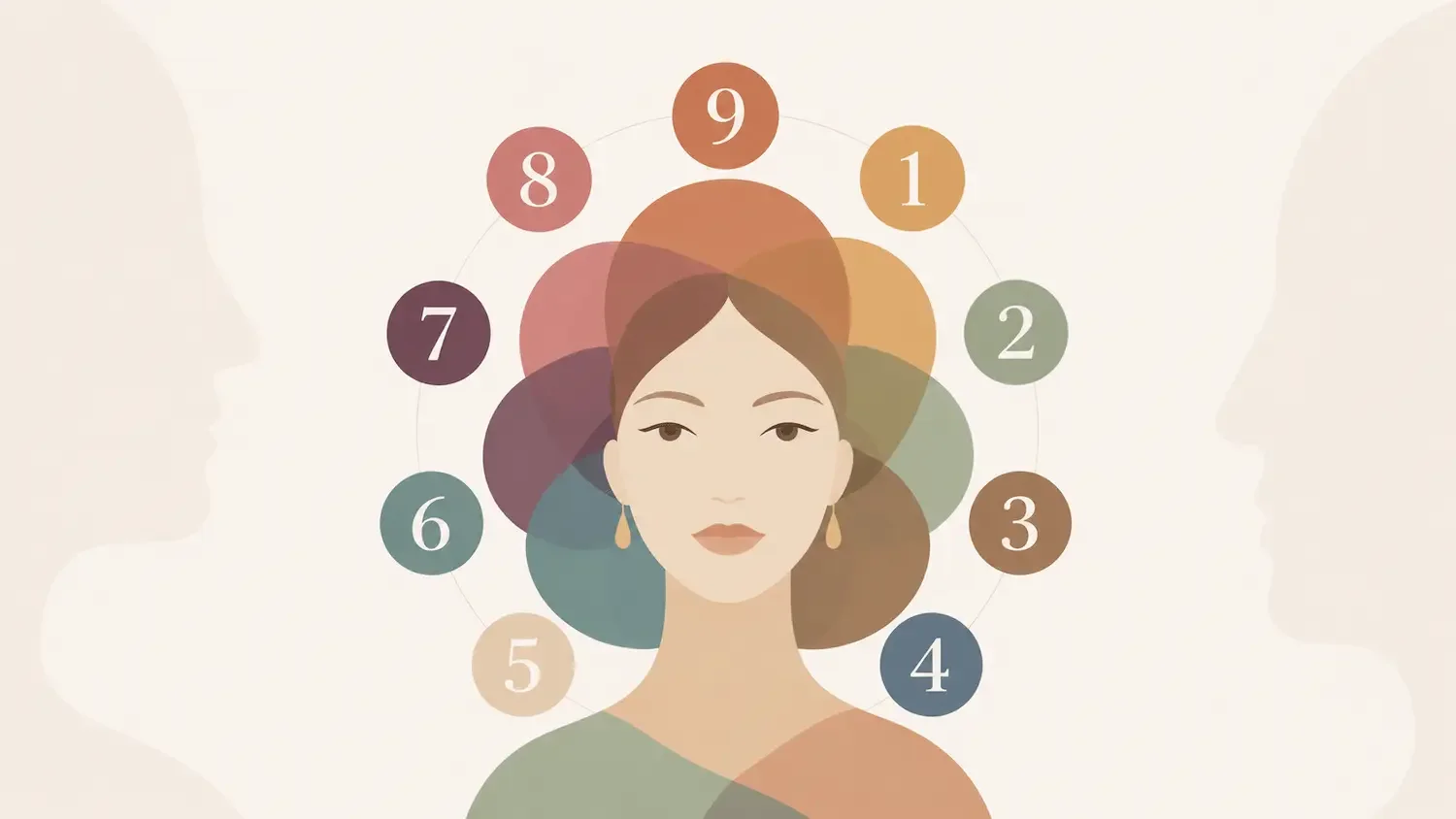
For a shorter introduction, watch or read the nine Enneagram types explained quickly. You can also browse the complete Enneagram type library before reading this evidence-aware guide in depth.
The Enneagram has a way of making people feel seen fast. Sometimes too fast.
For some, it becomes a powerful self-awareness tool. For others, it feels like personality astrology with better branding. The truth sits in the middle: the Enneagram can be meaningful and practically useful, but its scientific support is mixed, and it is best used with humility.
The 30-second answer
The Enneagram is a nine-type self-reflection system organized around traditional descriptions of motivation, fear and coping. Some measures show promising reliability, but a systematic review found mixed evidence and the model is not a clinical taxonomy. Use a result as a hypothesis to compare with real behavior—not proof of childhood history, compatibility or a fixed identity.
This guide covers:
- Where the Enneagram came from
- What the nine types are really about
- What research does and does not support
- How to use it without turning it into a label
- A quick relationship example to make it concrete
Psychdom content is educational only. It is not diagnosis or medical advice. If you are in distress or unsafe, seek local professional support.
Table of contents
What is the Enneagram?
The Enneagram is a personality typology made up of nine core patterns. Unlike many personality models that focus on traits, Enneagram teaching emphasizes motivation.
A useful shorthand:
- Your type describes the strategy you default to when you want safety, love, worth, control, or peace.
- The best use is self-reflection: noticing patterns, not defending them.
If you want a quick starting point, take the Enneagram test here, then come back and read the type descriptions to confirm your result.
A short history of the Enneagram
Modern Enneagram teaching commonly traces its spread through:
- G. I. Gurdjieff, who taught the nine-point symbol in the early 1900s
- Oscar Ichazo, credited with mapping personality patterns onto the structure in the 1960s
- Claudio Naranjo, who helped develop and popularize the personality-focused system in the 1970s
In plain English: the Enneagram of personality, as people use it today, is largely a modern synthesis that accelerated in the mid-to-late 20th century.
The nine Enneagram personality types, in plain English
Different schools use different names, but these quick descriptions point to the core motivation:
Type 1: The Reformer (The Improver)
Core motivation: To be good, ethical, and aligned with their values. Ones want to improve things, often starting with themselves.
Core fear: Being corrupt, wrong, or “not good enough”.
Under stress: The inner critic gets louder. Ones can become tense, impatient, and unusually reactive, especially when things feel messy or inefficient. They may nit-pick, over-control, or feel resentful that they are carrying the “right way” alone.
At their best: Principled, steady, and deeply reliable. Healthy Ones bring clarity, integrity, and real reform without turning it into perfectionism. They can inspire people through example rather than pressure.
One practical growth tip: Practice “good enough” on purpose once a day, and notice that nothing collapses. A tiny imperfection can be a form of freedom.
Type 2: The Helper (The Giver)
Core motivation: To be loved and needed, and to create closeness through support. Twos often sense what others need before it is said.
Core fear: Being unwanted, unlovable, or not worth prioritizing.
Under stress: They can overgive, overreach, or become quietly hurt when their efforts are not appreciated. Twos may struggle to name their own needs directly, then feel resentful when people do not magically recognize them.
At their best: Warm, generous, emotionally present, and uplifting. Healthy Twos give freely without keeping score, and they invite intimacy with honest self-expression, not self-sacrifice.
One practical growth tip: Before helping, pause and ask yourself: “Do I truly want to do this, or am I trying to earn something?”
Type 3: The Achiever (The Performer)
Core motivation: To succeed, be valued, and feel worthy through accomplishment. Threes are skilled at setting goals and getting results.
Core fear: Being worthless, failing, or having no inherent value beyond performance.
Under stress: They may become image-conscious, workaholic, or emotionally disconnected, focusing on productivity to outrun uncomfortable feelings. Some Threes keep moving so fast they lose contact with what they actually want.
At their best: Confident, efficient, motivating, and inspiring. Healthy Threes lead with authenticity, using their drive to build meaningful results, not just impressive ones.
One practical growth tip: Schedule one “no outcome” activity each week, purely for enjoyment. Your worth is not a KPI.
Type 4: The Individualist (The Romantic)
Core motivation: To understand themselves, feel emotionally honest, and live with meaning and authenticity. Fours crave depth and truth.
Core fear: Being insignificant, fundamentally flawed, or having no personal identity.
Under stress: They can spiral into comparison, longing, and the sense that something essential is missing. Fours may withdraw, ruminate, or intensify feelings in an attempt to feel real, but end up feeling more isolated.
At their best: Creative, compassionate, self-aware, and emotionally brave. Healthy Fours can hold their emotions without being consumed by them, and they make beauty from truth.
One practical growth tip: When you feel “behind” or “less than”, name three ordinary things that are actually working right now. Grounding is not betrayal.
Type 5: The Investigator (The Observer)
Core motivation: To understand the world, feel competent, and protect their energy and autonomy. Fives often value depth over breadth.
Core fear: Being overwhelmed, incompetent, or intruded upon.
Under stress: They may retreat, detach, or overthink, using distance and analysis as a shield. If demands pile up, a Five can feel depleted and become unusually irritable or shut down.
At their best: Insightful, calm, precise, and innovative. Healthy Fives share what they know, stay connected, and trust that participation will not empty them.
One practical growth tip: Practice a small “soft contact” habit, like sending one friendly message before you disappear into your own world. Connection can be low-drama.
Type 6: The Loyalist (The Guardian)
Core motivation: To feel safe, prepared, and supported. Sixes are alert to risk, loyalty, and what could go wrong, which can also make them excellent planners.
Core fear: Being unsupported, unsafe, or caught off guard.
Under stress: Anxiety can spike. Sixes may seek reassurance, second-guess decisions, or run worst-case scenarios on repeat. Some become cautious and compliant, others become skeptical and defiant, but both are usually driven by the same need for security.
At their best: Loyal, brave, grounded, and protective. Healthy Sixes build trust in themselves, not just in systems or authorities.
One practical growth tip: When your mind goes into “what if”, ask: “What is the next sensible step?” Just one step.
Type 7: The Enthusiast (The Optimist)
Core motivation: To feel free, happy, and stimulated, and to keep life full of possibility. Sevens love new experiences and future plans.
Core fear: Being trapped, deprived, or stuck in pain with no escape.
Under stress: They can become scattered, impulsive, or avoidant of difficult feelings. Some Sevens stay busy to outrun discomfort, then feel restless or dissatisfied when the excitement fades.
At their best: Joyful, imaginative, resilient, and energizing. Healthy Sevens can stay present, tolerate discomfort, and still keep their sense of hope.
One practical growth tip: Choose one thing to fully finish before starting something new. Completion can be its own kind of pleasure.
Type 8: The Challenger (The Protector)
Core motivation: To be strong, protect themselves, and avoid being controlled. Eights value honesty, loyalty, and directness.
Core fear: Being harmed, betrayed, or powerless.
Under stress: They may become intense, confrontational, or controlling, especially if they sense weakness, manipulation, or injustice. Eights can push hard to stay on top of situations that feel unsafe or uncertain.
At their best: Courageous, decisive, protective, and deeply committed. Healthy Eights use their power to stand up for people, not just to win. They soften without losing strength.
One practical growth tip: Practice naming what is vulnerable underneath the intensity, even if it is just one sentence. It builds real trust.
Type 9: The Peacemaker (The Mediator)
Core motivation: To keep inner and outer peace, avoid conflict, and maintain harmony. Nines often see multiple perspectives with ease.
Core fear: Loss of connection, conflict, or being forced into confrontation.
Under stress: They can shut down, procrastinate, or “go along” while quietly disconnecting. Nines may struggle to prioritize themselves, then feel stuck or resentful because their needs have gone missing.
At their best: Calm, steady, accepting, and unifying. Healthy Nines bring people together while still holding their own opinions, desires, and boundaries.
One practical growth tip: Make one small decision quickly each day, without overthinking. Your voice matters, even in tiny moments.
The important part is not the label. It is the pattern underneath it.\
Ready to narrow it down? Take the Enneagram test, then compare your top two results with the descriptions above
Is the Enneagram accurate? What research says
Many people experience the Enneagram as genuinely meaningful and practical, especially because it helps them name patterns around relationships, conflict, and stress. At the same time, the research base is mixed. Reviews of the literature note uneven evidence for reliability and validity across different measures and samples. Some studies find theory-consistent links with other personality constructs, but key claims are not consistently supported, and factor-analytic work does not always show a strong nine-type structure.
A fair summary is that some tools report acceptable internal consistency, while validation remains complicated, so it can still be useful as a growth framework even if it does not meet the strongest scientific standards in the way Big Five personality measures often do. Best practice is to use it to generate better questions about yourself, not to box people in, excuse behavior, or make clinical assumptions.
A brief note on wings
You will see labels like 8w7 or 2w1. A wing is not “your second-highest score.” In traditional Enneagram teaching, wings are one of the two adjacent types to your core type on the diagram.
Example:
- A Type 8 can have a 7 wing or a 9 wing
- A Type 2 can have a 1 wing or a 3 wing
Wings are best used as a light “flavor” descriptor, not a second identity.
Relationship example: Type 6w5 and Type 9w1
A common pairing dynamic is Type 6w5 as the careful planner and protector, with Type 9w1 as the steady harmonizer who keeps things grounded and fair. It often works well because both value commitment and stability, but they manage stress in very different ways.
At their best:
- The 6w5 brings loyalty, preparedness, and “let’s think this through” clarity. They spot risks early, ask smart questions, and help the relationship feel secure and well-run.
- The 9w1 brings calm, patience, and a quiet sense of integrity. They are reassuring in a warm, steady way and often soften conflict before it escalates.
Common friction:
- The 6w5 can become anxious, skeptical, or reassurance-seeking under pressure, pushing for certainty and answers right now.
- The 9w1 can minimize, delay, or go quiet to keep the peace, which can accidentally make the 6 feel more alone with the uncertainty.
A simple repair tool:
- 6w5s do well naming the emotion underneath the questions: “I’m feeling unsettled and I need reassurance and a clear plan.”
- 9w1s do well staying present and being gently direct: “I’m here, we’re okay, and I will talk this through with you. Let’s take it one step at a time.”
For a wider view of protective patterns between partners, read about Enneagram stress patterns in relationships or take the Conflict Style assessment.
How to use the Enneagram wisely
A few rules that keep it genuinely useful:
- Use it to spot your default stress moves and your repair moves.
- Use it to communicate needs more directly.
- Do not use it to justify harmful behavior.
- Do not use it to diagnose others.
- Hold it lightly. Self-awareness beats self-labeling.
Frequently asked questions
How do I find my Enneagram type without getting mistyped?
A good way to find your Enneagram type is to start with motivations, not behaviors. Many people mistype because they choose the type that matches their image, not the pattern underneath.
Try this:
- Narrow to your top 2–3 types by core motivation
- Read “under stress” patterns for each candidate
- Ask: “What do I do automatically when I feel unsafe, criticized, or uncertain?”
A test can help, but use it as a hypothesis, then validate with deeper reading.
How accurate are online Enneagram tests?
Online Enneagram tests can be useful for narrowing your options, but accuracy varies a lot. Many tests measure traits, while the Enneagram is meant to point to deeper motivation and coping strategy.
For better results:
- Take the test when you are calm, not in a reactive mood
- Look at your top two or three scores, not just the top one
- Validate by reading the full type descriptions and stress patterns
Can your Enneagram type change over time?
Most Enneagram traditions treat your core type as relatively stable, but your behavior can change significantly with growth, therapy, life stage, and environment.
If you feel like you “changed types”, it is often because:
- you were mistyped initially
- your stress level changed for a long period
- you learned healthier coping strategies that resemble another type
What are Enneagram triads (head, heart, and gut) and do they matter?
Triads group the nine types into three centers that often show up under pressure:
- Head types tend to manage fear through thinking, planning, or scanning for risk
- Heart types tend to manage shame or worth through image, connection, or emotional intensity
- Gut types tend to manage anger and autonomy through control, resistance, or keeping the peace
Triads can help you narrow your type if you are stuck between options.
What are instinctual subtypes (self-pres, social, one-to-one)?
Instinctual subtypes describe where your attention and stress response goes first:
- Self-preservation: safety, resources, comfort, stability
- Social: belonging, status, group roles, contribution
- One-to-one (intimacy): intensity, bonding, attraction, fusion or push-pull
They do not replace your type. They shape how your type presents.
What do Enneagram arrows mean (stress and growth)?
Arrows describe common shifts in behavior that can show up:
- under stress, when your usual strategy stops working
- in growth, when you gain access to new strengths
Different schools explain arrows differently, but the practical use is consistent: notice your “stress default”, then practice a small repair move earlier.
Enneagram vs MBTI vs Big Five: what’s the difference?
These models answer different questions:
- Enneagram: “Why do I react this way under stress, and what do I do to feel safe?”
- MBTI: “How do I prefer to take in information and make decisions?”
- Big Five: “What traits do I score higher or lower on, statistically speaking?”
Many people use Enneagram for growth work, MBTI for communication preferences, and Big Five for research-grade trait language.
Is the Enneagram spiritual, psychological, or both?
Historically, the Enneagram has roots in spiritual and personal-development communities, and modern use ranges from coaching to workplace workshops. Some people approach it as spirituality, others as psychology-adjacent self-reflection.
A grounded approach is to treat it as a framework for insight, not a fact about who you “are”.
How can the Enneagram help relationships without becoming a label?
Used well, the Enneagram helps couples and friends talk about patterns, not blame:
- what you do under stress
- what reassurance you need
- what conflict style you default to
- what repair looks like for you
The best relationship use is practical: one insight, one behavior change, repeated consistently.
References and further reading
If you’re curious about what research exists on the Enneagram’s reliability, validity, and practical usefulness, these sources are a solid starting point.
- Hook, J. N., Hall, T. W., Davis, D. E., Van Tongeren, D. R., & Conner, M. (2021). The Enneagram: A systematic review of the literature and directions for future research. Journal of Clinical Psychology, 77(4), 865–883. https://pubmed.ncbi.nlm.nih.gov/33332604/
- Newgent, R. A., Parr, P. E., Newman, I., & Higgins, K. K. (2004). The Riso-Hudson Enneagram Type Indicator: Estimates of reliability and validity. Measurement and Evaluation in Counseling and Development, 36(4), 226–237. https://eric.ed.gov/?id=EJ699124
- Sutton, A., Allinson, C., & Williams, H. (2013). Personality type and work-related outcomes: An exploratory application of the Enneagram model. European Management Journal, 31(3), 234–249. https://doi.org/10.1016/j.emj.2012.12.004
- Bland, A. M. (2010). The Enneagram: A review of the empirical and transformational literature. Journal of Humanistic Counseling, Education and Development, 49(1), 16–31. https://eric.ed.gov/?id=EJ886344
Ready to find your type?
If you are curious where you land, the simplest next step is to take the Enneagram test and treat the result as a starting point, not a verdict. Your best fit is usually the type whose core motivation and stress pattern feel uncomfortably accurate, even if you do not love the label. Once you have your top two, come back to this guide and read those sections slowly. The goal is not to “get it right” in one sitting, but to notice patterns with a bit more kindness and clarity.
Take the Enneagram Test