

What Kristen Bell’s Nobody Wants This reveals about our changing expectations of adulthood.
There is a photograph of a man in Oregon in 1939 who appears to have arrived at adulthood fully assembled. He has a pipe, suspenders, a pencil mustache and the sort of shoulders that make a gym membership look like an administrative complication. His wife sits behind him. Their accommodation appears to be a tent. He looks as though he could build a house, defend it and explain, without consulting a podcast, what was wrong with its foundations.
According to the identification published on the photography archive Shorpy, he was 27.
When the picture appeared on Reddit, one commenter responded, “27? Damn he looks older.” Another offered, “I've got some lumber he can work.” Between those two observations lies a surprisingly serviceable introduction to the psychology of adulthood.

The temptation is to turn him into a biological rebuke to the present: your grandfather had twice your testosterone, and now you need a recovery day after making a telephone call. There is a real finding beneath the meme. The Massachusetts Male Aging Study reported an age-independent decline in testosterone across its observation period (Travison et al., 2007). It did not establish that every grandfather carried twice his grandson’s testosterone, and it did not measure whether the grandsons could negotiate a lease or tolerate disappointment.
The photograph contains another inconvenient detail. Lange’s caption describes an unemployed lumber worker heading to the bean harvest with his wife. This is economic insecurity with excellent bone structure. His apparent self-possession tells us something about the image, something about our expectations, and very little about how he handled an argument.
Research on the attractiveness stereotype gives us reason to notice that leap: we often attribute desirable personal qualities to attractive people (Dion, Berscheid, & Walster, 1972). Here, we may be adding competence and maturity to the package. Still, the reaction is worth examining. What makes one 27-year-old look like an adult, while contemporary culture can make middle age feel like an extended audition for the role?
The adulthood problem in Nobody Wants This
Netflix’s Nobody Wants This supplies an appealing setting for that question. Kristen Bell was born on July 18, 1980; Adam Brody on December 15, 1979. Both are 46 as of September 19, 2026, and both were 44 when the series premiered in 2024. These are the performers’ ages, not verified birth dates for their characters. (Bell biography; Brody biography.)
Spoilers for seasons one and two follow.
Joanne is an agnostic podcaster; Noah is a rabbi. Their relationship has to accommodate family expectations, religious identity and his career. In season two’s ninth episode, Joanne’s eviction brings cohabitation into focus, but Noah hesitates while her possible conversion remains unresolved. Netflix’s own account also describes a revealing misunderstanding: Joanne thought the conversion question had been set aside indefinitely; Noah understood it as postponed. (Netflix’s season-two explainer.)
The viewer’s impatient response is easy to understand: surely, by this point, somebody could have clarified the terms. The ambiguity has the familiar texture of younger dating, even when the people performing it are well into their forties.
Yet having an unresolved question about faith is not childish. Nor is falling in love at 46. The developmental issue is how people handle an incompatibility: whether they name it, negotiate it and accept its possible consequences, or preserve the romance by allowing each person to believe something different.
Our discussion of the paradox of choice in modern dating considers a related temptation: keeping possibilities open can feel safer than choosing a life that necessarily closes some of them.
The easy joke would have Bell and Brody choosing assisted living instead of choosing whose apartment to share. The history does not support it. Forty-somethings were not routinely on the threshold of institutional care two generations ago; even in 1940, Americans who reached 65 had roughly another 12 to 13 years of life expectancy. (Social Security historical tables.) The meaningful comparison concerns the responsibilities expected at a given age.
The house got further away
“By your age, I had a house and two children” is a statement about a life. It becomes a psychological diagnosis only when we forget the conditions under which that life was assembled.
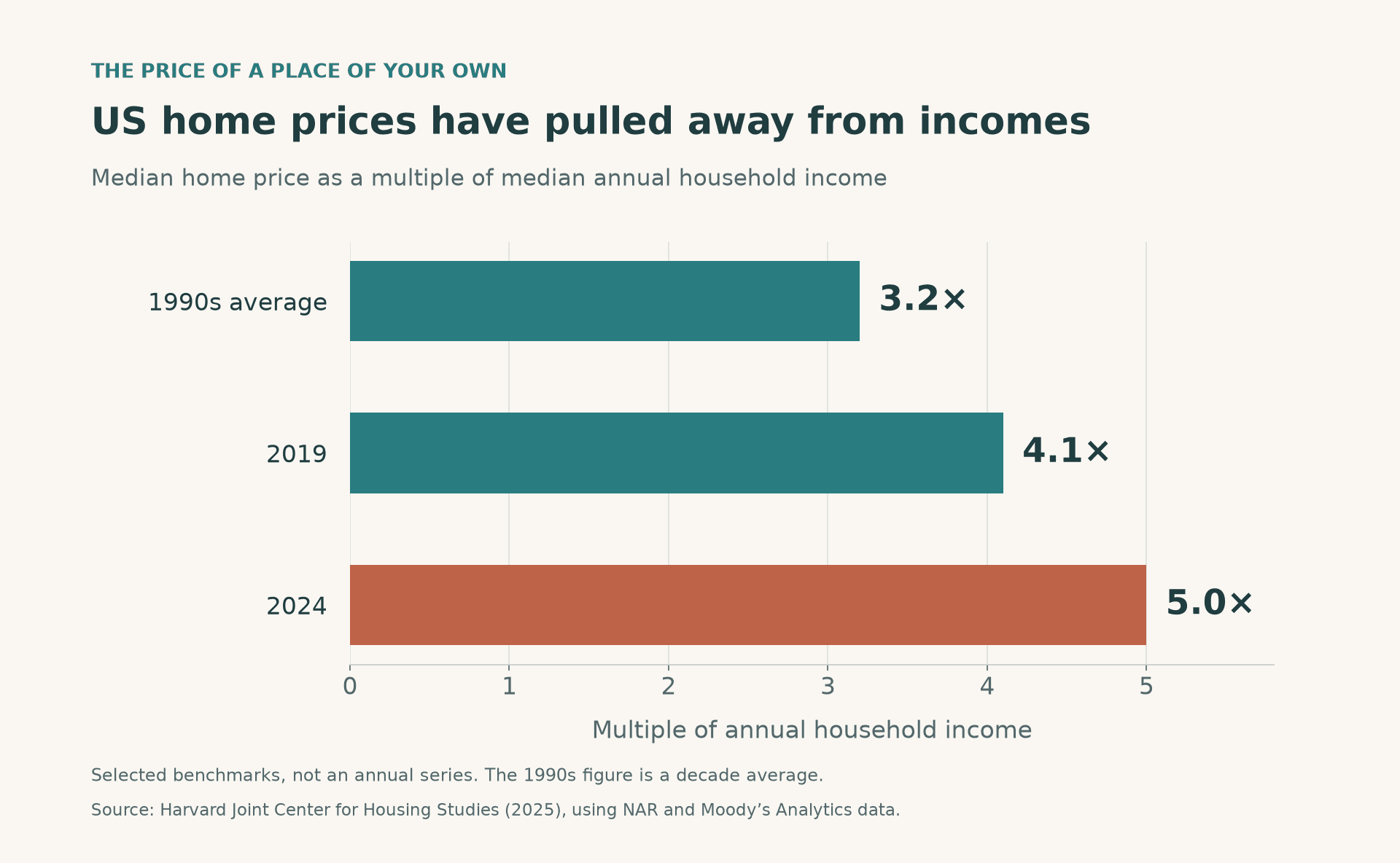
Harvard’s Joint Center for Housing Studies reports that the national median single-family home price reached five times median household income in 2024, compared with 4.1 times in 2019 and a 1990s average of 3.2. These are household incomes, potentially including more than one earner, rather than an individual’s salary. (JCHS, 2025.)
That does not prove every baby boomer had an easy start or every millennial has an impossible one. Nor should a Depression-era migrant worker be casually recruited into a story about comfortable postwar homeownership. Those are different histories. Generation X, millennials and Gen Z also contain people who inherited deposits, people who support their parents and people who have never had family money to fall back on.
But the arithmetic changes the meaning of delay. Saving for independence can require remaining dependent for longer. A childhood bedroom becomes a financial strategy. An adult can be earning, budgeting and behaving responsibly while still needing to explain to a parent why they came home at midnight.
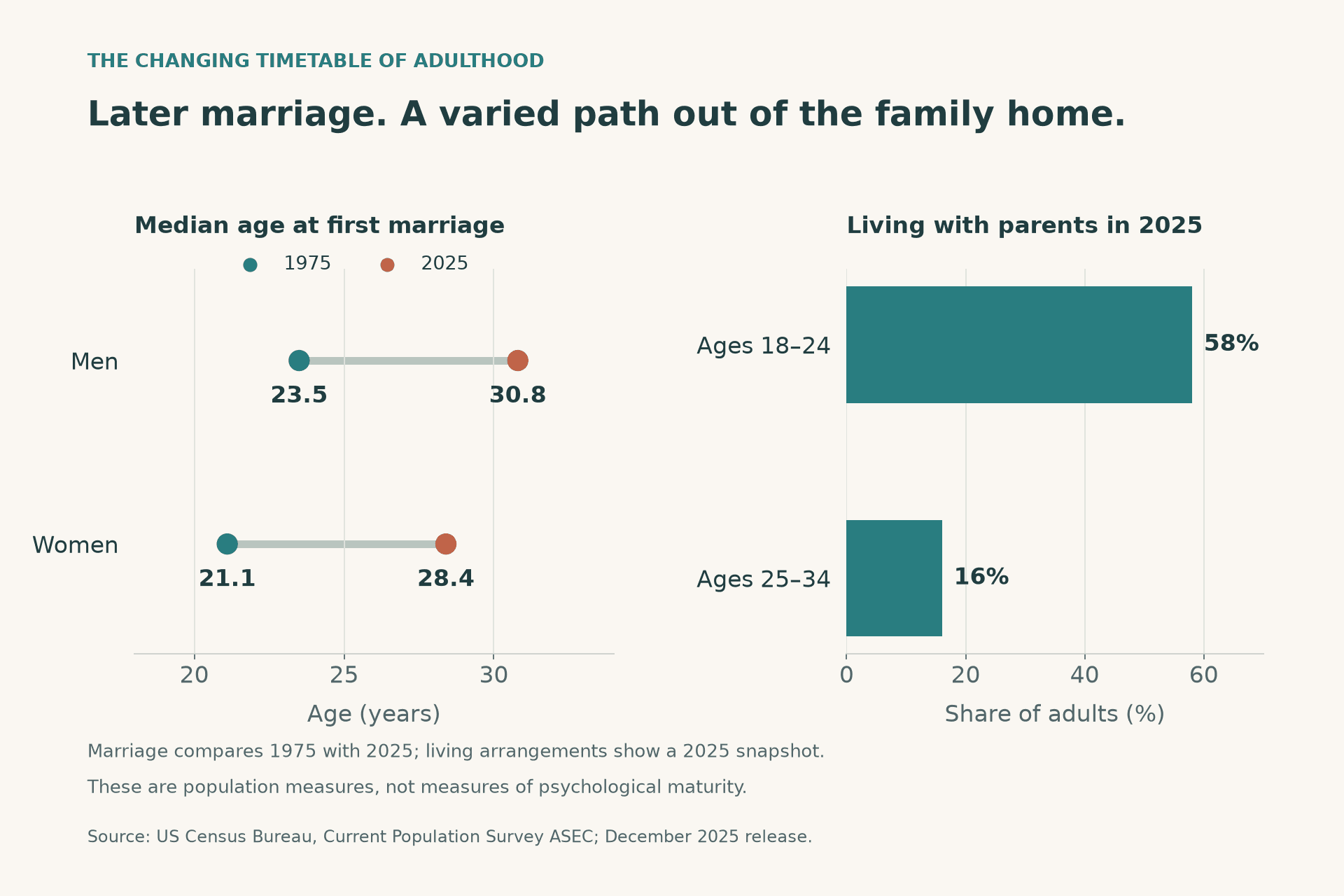
The US Census Bureau puts the median age at first marriage in 2025 at 30.8 for men and 28.4 for women, compared with 23.5 and 21.1 in 1975. In 2025, 58 percent of 18-to-24-year-olds and 16 percent of 25-to-34-year-olds lived in their parental home. Those figures describe living arrangements, not a national failure of character. (US Census Bureau, 2025.)
Marriage, homeownership and parenthood remain significant commitments. They are also imperfect certificates of maturity. A person can be single, renting and thoroughly dependable. Another can own a house and expect everyone in it to regulate his moods.
Becoming adult takes practice
Psychologist Jeffrey Arnett’s theory of emerging adulthood describes an extended period of identity exploration between adolescence and settled adult roles, originally focusing on ages 18 to 25 (Arnett, 2000). It is shaped by cultural and economic possibilities. It is not a diagnosis, and it does not give us a scientific basis for calling every indecisive 45-year-old an adolescent.
Development also continues after that period. A meta-analysis of 92 longitudinal samples found average increases in conscientiousness and emotional stability, especially between 20 and 40 (Roberts, Walton, & Viechtbauer, 2006). Age does not leave personality untouched; neither does it make everyone develop at the same pace.
Social investment theory helps explain why responsibilities may matter. Work, relationships and community commitments repeatedly ask people to show up, coordinate with others and follow through. In a longitudinal study, increasing psychological investment in work was associated with increasing conscientiousness over approximately three years (Hudson, Roberts, & Lodi-Smith, 2012). Selection and influence can operate together: responsible people may invest more in roles, and those roles may encourage further development.
The intriguing possibility is that delayed access to stable adult roles can also delay some opportunities to practise adulthood. That is a hypothesis connecting the research to our economic circumstances. It is not a demonstrated causal chain from expensive houses to emotional immaturity.
There is an equally important counterpoint. Mehta and colleagues describe ages 30 to 45 as established adulthood, a period when careers, partnerships and caring responsibilities can become intensely demanding (Mehta et al., 2020). Many adults are carrying several generations’ needs at once. They would be surprised to discover they were enjoying an extended childhood.
The question is who gets meaningful responsibility, who has it piled upon them, and who is repeatedly relieved of it.
When help becomes infantilization
An adult living at home may pay bills, cook dinner and care for an ill parent. Another may expect the household to operate as a hotel with a complaints department. The postal address is the same; the relationship to responsibility is different.
Here, infantilization has a useful, specific meaning: treating someone capable of adult agency as though ordinary decisions and consequences should be managed for them. It can involve parents, institutions and the adult child’s own expectations. It is a pattern to examine, rather than a label to attach to a generation.

The university version is familiar enough to have generated its own advice literature. In an Illinois State University article about parents contacting staff over issues including grades, professor Ani Yazedjian said: “I’ve had my share of parents who call, and not all have been very nice.” Her advice emphasized understanding the parent’s perspective rather than immediately becoming defensive. (Illinois State University, 2014.)
One professor’s experience cannot establish how common this is, or whether today’s students are worse than yesterday’s. It does illustrate the question: who gets to practise dealing with disappointment and an authority figure?
Self-determination theory identifies autonomy, competence and relatedness as basic psychological needs. Schiffrin and colleagues used this framework in a study of 297 college students. Reported parental overcontrol was associated with more depressive symptoms and lower life satisfaction; frustrated autonomy and competence helped account for those associations (Schiffrin et al., 2014).
A later meta-analysis of 53 studies found helicopter parenting associated with poorer self-efficacy, regulatory skills and academic adjustment, as well as more internalizing symptoms such as anxiety and depression (McCoy, Dimler, & Rodrigues, 2025). These associations do not establish one-way causation. An anxious young person can elicit more parental intervention, and families differ in why they provide help.
Still, a plausible loop emerges: an adult anticipates difficulty; a parent takes over; the difficulty disappears; the adult loses an opportunity to discover that they could have managed it. Both receive immediate relief. Neither necessarily gets better at tolerating the next problem.
Laundry makes an easy joke because the task is ordinary and learnable. But we should apply the test consistently. A grandfather whose wife handled every meal, appointment and clean shirt was not necessarily more self-sufficient than the grandson being mocked for domestic incompetence. Sometimes dependence has simply worn a more respectable uniform.
Christmas cake, leftover women and the social clock
The social clock is the timetable a culture attaches to a life: finish school, leave home, marry, have children, acquire standing. Missing the schedule can produce shame even when the decision is thoughtful and practical.
Japan’s historical “Christmas cake” insult made that timetable unusually explicit. Women unmarried after 25 were likened to cake left unsold after December 25. Research discussing adult identity in Japan places the expression within a gendered life course that expected women to marry, leave employment and care for a family (Mandujano-Salazar, 2019).
The insult tells us how the timetable was enforced. It does not tell us that the people who met it were emotionally ready. An early wedding can express a mature commitment; it can also reflect economic dependence, conformity or an absence of acceptable alternatives.
The timetable has shifted. Japan’s 2025 National Fertility Survey reports that the proportion of unmarried 18-to-34-year-olds intending eventually to marry fell to 75.1 percent among men and 77.8 percent among women, compared with 81.4 and 84.3 percent in the previous survey. These are intentions among unmarried respondents, not the percentages of all young Japanese people who will marry. (National Institute of Population and Social Security Research.)
China’s label sheng nü, commonly translated as “leftover women,” similarly turns a woman’s unmarried status into a public verdict. Research on urban marriage patterns links the difficulties faced by older, highly educated women to persistent gender expectations alongside expanding educational opportunities (Qian & Qian, 2014). Interview research on parental pressure describes women negotiating different ideas about marriage, gender roles and personal autonomy across generations (Gui, 2023).
These cases complicate a simple story of adults refusing to grow up. A woman who declines a marriage that requires her to surrender a career may be exercising precisely the agency adulthood is supposed to confer. Conversely, an adult whose parents conduct all the negotiations can meet the traditional milestone while remaining dependent in the decision itself.
Japan and China are distinct societies, and neither has a single explanation for changing marriage patterns. Their relevance here is the tension between personal development and a socially approved schedule. Being on time and being ready are different achievements.
What the television couple gets right
This brings us back to Joanne and Noah. The defensible criticism of Nobody Wants This concerns the way adult uncertainty can be stretched into a romantic atmosphere. The audience is invited to enjoy the suspense of commitment while becoming impatient with the work it requires.
But the show also allows its characters to recognise mistakes and make choices. Bell’s description of the couple’s approach is instructive: “It’s not Noah against Joanne … it’s Joanne and Noah against the problem.” (Netflix.) That is a more useful standard for adulthood than the birthday printed beneath an actor’s photograph.
Can you listen without treating disagreement as rejection? Can you state what you need without arranging for somebody else to guess? Can you admit that a person you love may want a life you cannot give them? Those are developmental tasks at 24, 44 and 74. Our account of conflict styles in relationships explores how avoidance and collaboration can shape those conversations.
The promise of eternal youth is that nothing has to become final. The cost is that other people may be required to live indefinitely inside your indecision.
Meanwhile, the grown-ups will not leave the room
There is something disorienting about a culture that questions whether people in their thirties are ready to assume adult responsibility while concentrating political authority in people more than twice their age.
On this article’s publication date, September 19, 2026, President Donald Trump is 80, his predecessor Joe Biden is 83, and Senator Mitch McConnell is 84. Their birth dates are June 14, 1946; November 20, 1942; and February 20, 1942, respectively. (Trump biography; Biden biography; McConnell biography.)

McConnell’s September 14 statement announced his return to Senate voting after a June fall and described recovery complicated by the effects of childhood polio. (Statement from McConnell’s office.) The scene invites the familiar Weekend at Bernie’s joke. But a photograph cannot establish mental capacity, and a wheelchair is not evidence that someone is unable to make decisions.
The institutional question survives without that insinuation. How well do political systems plan for succession? How much authority is retained through incumbency, networks and the difficulty of dislodging an established figure? What happens when younger adults are told to become responsible but are given little opportunity to exercise meaningful power?
Developmental psychologist Erik Erikson used generativity to describe an adult concern with contributing to the lives of subsequent generations. Applied here as an interpretive lens, it asks something of older adults too: whether their accumulated experience enables others to grow, and whether they can make room for those who follow.
Thomas Cave’s photograph cannot settle whether adults used to be tougher. A television romance cannot diagnose a generation. Together, however, they expose the strange mismatch between the appearance of adulthood, its economic conditions and its psychological demands.
Growing up involves accepting that other people have needs, that choices have costs and that a life cannot remain an unlimited set of possibilities. It also requires opportunities to act, fail, recover and become useful. Families can provide those opportunities. Institutions can provide them. Both can withhold them while complaining that the next generation lacks initiative.
Perhaps nobody wants to grow up. Or perhaps we have become confused about what growing up should mean—and who is willing to let it happen.
References and sources
Development, personality and parenting
Arnett, J. J. (2000). Emerging adulthood: A theory of development from the late teens through the twenties. American Psychologist, 55(5), 469–480.
Dion, K., Berscheid, E., & Walster, E. (1972). What is beautiful is good. Journal of Personality and Social Psychology, 24(3), 285–290.
Erikson, E. H. (1950). Childhood and Society. W. W. Norton. Foundational account of psychosocial development, including generativity versus stagnation; used here as theory rather than evidence about particular politicians.
Hudson, N. W., Roberts, B. W., & Lodi-Smith, J. (2012). Personality trait development and social investment in work. Journal of Research in Personality, 46(3), 334–344.
McCoy, S. S., Dimler, L. M., & Rodrigues, L. (2025). Parenting in overdrive: A meta-analysis of helicopter parenting across multiple indices of emerging adult functioning. Journal of Adult Development, 32, 222–245. Published online in 2024; journal volume dated 2025.
Mehta, C. M., Arnett, J. J., Palmer, C. G., & Nelson, L. J. (2020). Established adulthood: A new conception of ages 30 to 45. American Psychologist, 75(4), 431–444.
Roberts, B. W., Walton, K. E., & Viechtbauer, W. (2006). Patterns of mean-level change in personality traits across the life course: A meta-analysis of longitudinal studies. Psychological Bulletin, 132(1), 1–25.
Schiffrin, H. H., Liss, M., Miles-McLean, H., Geary, K. A., Erchull, M. J., & Tashner, T. (2014). Helping or hovering? The effects of helicopter parenting on college students’ well-being. Journal of Child and Family Studies, 23, 548–557.
Culture, history and biology
Gui, T. (2023). Coping with parental pressure to get married: Perspectives from Chinese “leftover women”. Journal of Family Issues. Qualitative research on intergenerational expectations and autonomy.
Mandujano-Salazar, Y. Y. (2019). Exploring the construction of adulthood and gender identity among single childfree people in Mexico and Japan. SAGE Open, 9(2).
Qian, Y., & Qian, Z. (2014). The gender divide in urban China: Singlehood and assortative mating by age and education. Demographic Research, 31, 1337–1364.
Travison, T. G., Araujo, A. B., O’Donnell, A. B., Kupelian, V., & McKinlay, J. B. (2007). A population-level decline in serum testosterone levels in American men. The Journal of Clinical Endocrinology & Metabolism, 92(1), 196–202.
National Institute of Population and Social Security Research. The Seventeenth Japanese National Fertility Survey. Survey conducted in June 2025; marriage-intention figures concern unmarried respondents aged 18–34.
Chart data and reporting
Whitney, P. (2025, October 6). Home prices surge to five times median income, nearing historic highs. Harvard Joint Center for Housing Studies. Source for the three housing benchmarks; JCHS tabulations use National Association of Realtors and Moody’s Analytics data.
US Census Bureau. (2025, December 2). Census Bureau releases new estimates on America’s families and living arrangements. Current Population Survey Annual Social and Economic Supplement. Source for marriage ages and parental-home shares; the charts are original Psychdom presentations of these published figures.
Illinois State University. (2014). Dealing with helicopter parents. Source of Ani Yazedjian’s quotation.
Bitran, T. (2025, October 27). Nobody Wants This season 2 ending explained. Netflix Tudum. Source for the season-two plot details and Kristen Bell’s quotation.
Lange, D. (1939). Unemployed lumber worker goes with his wife to the bean harvest. Library of Congress. The later Thomas Cave identification comes from Shorpy; public reactions are quoted from the linked Reddit discussion.
US Social Security Administration. Historical period life expectancy, Table V.A3. Historical figures cited for people who had reached age 65.
US Senator Mitch McConnell. (2026, September 14). Update from Senator Mitch McConnell. Ages of performers and political figures are calculated for September 19, 2026, from the biographical sources linked in the text.